

Which Cellular Structure Is Unique To Animal Cells?

Animal Jail cell Construction
Animal cells are typical of the eukaryotic cell, enclosed by a plasma membrane and containing a membrane-bound nucleus and organelles. Dissimilar the eukaryotic cells of plants and fungi, animal cells practise not have a prison cell wall. This feature was lost in the afar past by the single-celled organisms that gave ascension to the kingdom Animalia. Near cells, both animal and plant, range in size between 1 and 100 micrometers and are thus visible only with the aid of a microscope.
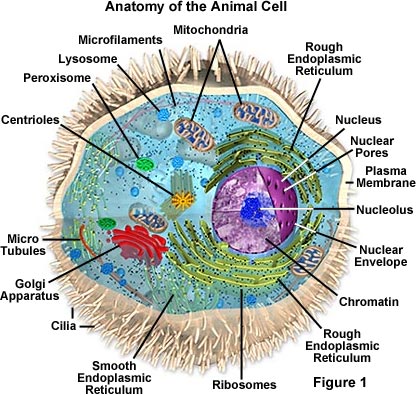
The lack of a rigid cell wall allowed animals to develop a greater variety of prison cell types, tissues, and organs. Specialized cells that formed fretfulness and muscles�tissues impossible for plants to evolve�gave these organisms mobility. The power to motion nigh past the use of specialized musculus tissues is a authentication of the animal world, though a few animals, primarily sponges, do not possess differentiated tissues. Notably, protozoans locomote, but information technology is but via nonmuscular means, in upshot, using cilia, flagella, and pseudopodia.
The beast kingdom is unique among eukaryotic organisms considering virtually animal tissues are bound together in an extracellular matrix by a triple helix of protein known as collagen. Plant and fungal cells are bound together in tissues or aggregations past other molecules, such as pectin. The fact that no other organisms use collagen in this manner is one of the indications that all animals arose from a common unicellular antecedent. Basic, shells, spicules, and other hardened structures are formed when the collagen-containing extracellular matrix between animal cells becomes calcified.
Animals are a large and incredibly diverse grouping of organisms. Making up nigh three-quarters of the species on Earth, they run the gamut from corals and jellyfish to ants, whales, elephants, and, of course, humans. Being mobile has given animals, which are capable of sensing and responding to their environment, the flexibility to prefer many different modes of feeding, defense, and reproduction. Unlike plants, all the same, animals are unable to manufacture their own food, and therefore, are always directly or indirectly dependent on plant life.
Most animal cells are diploid, meaning that their chromosomes exist in homologous pairs. Unlike chromosomal ploidies are also, however, known to occasionally occur. The proliferation of animal cells occurs in a variety of ways. In instances of sexual reproduction, the cellular process of meiosis is first necessary so that haploid daughter cells, or gametes, tin can exist produced. Ii haploid cells then fuse to form a diploid zygote, which develops into a new organism as its cells separate and multiply.
The earliest fossil evidence of animals dates from the Vendian Period (650 to 544 million years ago), with coelenterate-type creatures that left traces of their soft bodies in shallow-water sediments. The first mass extinction concluded that period, but during the Cambrian Period which followed, an explosion of new forms began the evolutionary radiations that produced virtually of the major groups, or phyla, known today. Vertebrates (animals with backbones) are not known to have occurred until the early on Ordovician Period (505 to 438 million years ago).
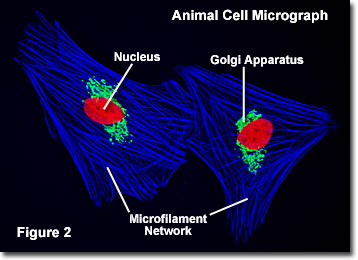
Cells were discovered in 1665 past British scientist Robert Hooke who commencement observed them in his crude (by today'south standards) seventeenth century optical microscope. In fact, Hooke coined the term "cell", in a biological context, when he described the microscopic structure of cork like a tiny, bare room or monk's cell. Illustrated in Figure 2 are a pair of fibroblast deer pare cells that have been labeled with fluorescent probes and photographed in the microscope to reveal their internal construction. The nuclei are stained with a cerise probe, while the Golgi apparatus and microfilament actin network are stained green and bluish, respectively. The microscope has been a central tool in the field of jail cell biology and is often used to observe living cells in civilization. Use the links below to obtain more detailed information nearly the various components that are found in animal cells.
-
Centrioles - Centrioles are self-replicating organelles fabricated up of 9 bundles of microtubules and are found merely in animate being cells. They announced to help in organizing cell partition, only aren't essential to the process.
-
Cilia and Flagella - For unmarried-celled eukaryotes, cilia and flagella are essential for the locomotion of individual organisms. In multicellular organisms, cilia function to move fluid or materials by an immobile cell as well as moving a jail cell or group of cells.
-
Endoplasmic Reticulum - The endoplasmic reticulum is a network of sacs that manufactures, processes, and transports chemical compounds for use inside and outside of the prison cell. It is connected to the double-layered nuclear envelope, providing a pipeline between the nucleus and the cytoplasm.
-
Endosomes and Endocytosis - Endosomes are membrane-bound vesicles, formed via a complex family of processes collectively known as endocytosis, and found in the cytoplasm of well-nigh every animal cell. The basic mechanism of endocytosis is the reverse of what occurs during exocytosis or cellular secretion. It involves the invagination (folding in) of a prison cell's plasma membrane to environment macromolecules or other affair diffusing through the extracellular fluid.
-
Golgi Apparatus - The Golgi apparatus is the distribution and shipping department for the jail cell's chemical products. It modifies proteins and fats built in the endoplasmic reticulum and prepares them for export to the outside of the cell.
-
Intermediate Filaments - Intermediate filaments are a very broad form of gristly proteins that play an important role equally both structural and functional elements of the cytoskeleton. Ranging in size from viii to 12 nanometers, intermediate filaments role as tension-begetting elements to help maintain cell shape and rigidity.
-
Lysosomes - The main function of these microbodies is digestion. Lysosomes suspension down cellular waste product products and debris from outside the cell into simple compounds, which are transferred to the cytoplasm as new cell-building materials.
-
Microfilaments - Microfilaments are solid rods made of globular proteins chosen actin. These filaments are primarily structural in office and are an of import component of the cytoskeleton.
-
Microtubules - These straight, hollow cylinders are found throughout the cytoplasm of all eukaryotic cells (prokaryotes don't have them) and carry out a variety of functions, ranging from ship to structural support.
-
Mitochondria - Mitochondria are ellipsoidal shaped organelles that are plant in the cytoplasm of every eukaryotic cell. In the animate being cell, they are the main ability generators, converting oxygen and nutrients into energy.
-
Nucleus - The nucleus is a highly specialized organelle that serves as the information processing and administrative heart of the cell. This organelle has two major functions: information technology stores the cell's hereditary material, or Deoxyribonucleic acid, and information technology coordinates the prison cell's activities, which include growth, intermediary metabolism, protein synthesis, and reproduction (prison cell partitioning).
-
Peroxisomes - Microbodies are a various group of organelles that are found in the cytoplasm, roughly spherical and bound past a single membrane. There are several types of microbodies only peroxisomes are the most common.
-
Plasma Membrane - All living cells have a plasma membrane that encloses their contents. In prokaryotes, the membrane is the inner layer of protection surrounded by a rigid prison cell wall. Eukaryotic brute cells accept only the membrane to contain and protect their contents. These membranes also regulate the passage of molecules in and out of the cells.
-
Ribosomes - All living cells contain ribosomes, tiny organelles composed of approximately threescore percent RNA and 40 pct protein. In eukaryotes, ribosomes are made of four strands of RNA. In prokaryotes, they consist of 3 strands of RNA.
In improver the optical and electron microscope, scientists are able to apply a number of other techniques to probe the mysteries of the animal cell. Cells tin can be disassembled by chemical methods and their individual organelles and macromolecules isolated for study. The process of cell fractionation enables the scientist to prepare specific components, the mitochondria for instance, in large quantities for investigations of their composition and functions. Using this approach, jail cell biologists have been able to assign diverse functions to specific locations within the jail cell. Yet, the era of fluorescent proteins has brought microscopy to the forefront of biology by enabling scientists to target living cells with highly localized probes for studies that don't interfere with the delicate residue of life processes.
BACK TO CELL STRUCTURE HOME
BACK TO FLUORESCENCE MICROSCOPY OF CELLS
Questions or comments? Send u.s. an email.
© 1995-2022 past Michael Due west. Davidson and The Florida Land University. All Rights Reserved. No images, graphics, software, scripts, or applets may be reproduced or used in any manner without permission from the copyright holders. Use of this website ways yous agree to all of the Legal Terms and Weather set forth past the owners.
This website is maintained by our
Graphics & Web Programming Team
in collaboration with Optical Microscopy at the
National Loftier Magnetic Field Laboratory.
Final modification: Friday, November 13, 2015 at 02:18 PM
Admission Count Since October ane, 2000: 6342740
Microscopes provided by:


Source: https://micro.magnet.fsu.edu/cells/animalcell.html
Posted by: trappawkwast86.blogspot.com
0 Response to "Which Cellular Structure Is Unique To Animal Cells?"
Post a Comment